
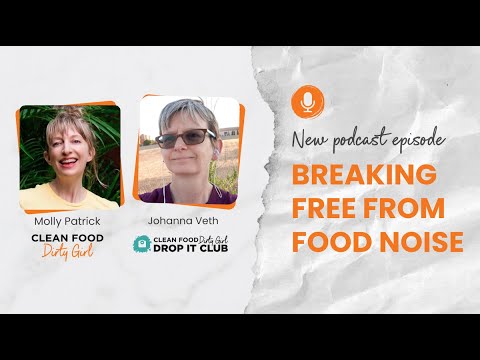
149: Breaking Free From Food Noise
This episode is a tad sweary.


Show notes:
In this episode, I talk with Johanna, a former Drop It Club member, about her journey with plant-powered weight loss. Johanna shares what led her from vegetarian to fully plant-based, why traditional nutrition advice left her feeling defeated, and how Drop It Club helped her release weight (and unhelpful habits) without tracking, restriction, or obsessing over food.
We discuss how eating three satisfying meals a day reduced mental load, ended constant snacking, and created unexpected emotional lightness and clarity. This conversation goes beyond the scale and into how this way of eating feels good enough to maintain for life.
Helpful links
- Nut-free Swiss-style Cheesy Sauce
- Drop It Club, our plant-fueled weight loss program
- Recipe Club, access over 5,200 WFPB recipes for just $12 per month
Transcript (auto-generated, may have errors)
Molly Patrick (00:00.717)
Hey there, and thank you for listening to this episode of the Clean Food Dirty Girl podcast. Today I’m talking with Johanna. Johanna was a “droplet,” as we call people in our Drop It program.
Johanna, you joined fairly early on and you recently canceled. We were talking about this before we hit record, and I was saying that I actually love it when I see people cancel because they feel like they got what they needed from it. They got results, they know what to do going forward, so they don’t need it anymore. That’s the best-case scenario for me—people canceling because they’ve got this.
After being a droplet for a while, you were seeing results and you felt like you had it. So thank you for talking with me today. I’m super happy to dive in and talk with you about your experience.
Johanna (00:58.062)
Yeah, it’s a pleasure. Thanks for having me.
Molly Patrick (01:00.469)
So, there were a few things that stood out to me when we were emailing. One was how much you loved that this was a plant-based solution. This is very niche—our program is plant-powered weight loss. People who aren’t into eating plant-based or don’t want to eat plant-based are not a fit.
But people who are open to it, who have eaten plant-based in the past and want to get back to it, or who want to eat mainly plant-based—this is a really good solution. Can you talk a little about your interest in that aspect?
Johanna (01:49.678)
Sure. I’ve been plant-based for a few years now and vegetarian before that. As a vegetarian, I was terribly overweight because I loved cheese so much. I ate it with every meal. Eventually I became plant-based and kicked the cheese habit, which was great.
More recently I went through perimenopause and the weight crept on around my middle. I worked with nutritionists on a couple of occasions who weren’t really plant-based, although they said they could support me. They always treated my decision to be plant-based as a problem they needed to solve:
“You really have to be careful about your protein. You need to make sure you get enough protein in your diet.”
It always wore me down. It wasn’t a positive way to approach my situation, and I didn’t want to hear that. I wanted something more positive.
That’s why Drop It has been so fantastic. I don’t have to worry about those conversations. I don’t have anyone making me feel like I’m a problem because of my choice. I genuinely believe a whole food plant-based diet is the best diet for longevity and healthy living and hopefully avoiding some of the more terrible aspects of aging. That’s what really switched me on to Drop It.
Molly Patrick (03:48.471)
When you’re eating in a way that aligns with your values and how you want to show up in the world, that’s powerful. Working with professionals who see your choices as a problem can be really defeating. We don’t want to have to justify our choices to people who don’t know what to do with them.
Finding something that aligns with our values, desires, and how we want to show up in the world is important. And again, for people who don’t want to eat plant-based, this isn’t the thing, because it is plant-powered. It’s not just about the food, but food is a big component.
I want people to reach their goal weight—that’s great, this is a plant-powered weight loss program—but I also want people to be damn healthy and live a long, healthy, enjoyable life. Like you, I think this way of eating is a powerful way to do that. It is about weight, and also about so much more.
I’m thrilled you found something that fit with what felt good to you. This has to feel good if we want to do it long term.
Johanna (05:34.626)
Yeah, that’s right. Also, with those other nutritionists, it was all about writing down everything I ate for every meal and having it checked by someone. It was just too hard.
That’s the other great thing about Drop It—it’s kind of effortless if you’re already plant-based. You don’t have to think too much about it.
Molly Patrick (06:03.328)
I don’t want anybody to babysit what they’re eating or babysit their food. People who are used to tracking—calories, macros, portions—often find that when they stop and see they can release weight and be healthy without keeping track of so many things, they already feel lighter. It’s a whole thing they don’t have to put energy into. That takes up so much mental bandwidth.
You mentioned that people you’d worked with before wanted you to eat six little meals a day, and you felt like it was too much because you ended up eating when you weren’t hungry. In Drop It, one of the guidelines in all three phases is: you eat three meals a day and you eat enough so you feel really satisfied.
Talk about that shift and how it changed things for you.
Johanna (07:23.374)
That was such a godsend for me. When I was supposed to be eating three meals plus three snacks a day, I was constantly thinking about food—what I was going to eat next.
Because they were always worried about protein, they’d say, “Have some coconut yogurt with something.” Coconut yogurt, apart from being really high in fat, is also really expensive here in New Zealand. And I wasn’t hungry. I didn’t want all that food. It was stressful to have to come up with something to eat.
Then it might end up being too much peanut butter. That was always a way of consuming calories I didn’t need, because I didn’t actually want them.
So the three meals a day has been fantastic. I know for other droplets it’s been hard to adjust to, but for me it’s been great. I know I have my three meals prepared. That should be sufficient. If it’s not, then goddammit, I’ll eat a piece of fruit—and that’s fine.
Molly Patrick (09:02.378)
Exactly. We don’t want you eating between meals, but if you need to, have fruit or veggies. Don’t use it as an opportunity to load up on peanut butter crackers or whatever.
Part of this is about: where can we easily eliminate unnecessary calories? When I designed this program, I looked at the lowest-hanging fruit—excess calories people don’t really need but tend to consume the most, that aren’t necessary and are easiest to tackle. That’s phase one.
You said if you’re already eating plant-based or open to it, it’s kind of effortless. I think that’s why. We’re not having you jump through hoops or do mental gymnastics. Having three meals a day and just fruit or veggies for snacks, if needed, eliminates a lot of choices. Fewer choices are easier for our brain.
Of course it takes some planning and prep so you have your three meals and know what you’re eating. But it’s fantastic to know that in advance so you can prep. People do struggle with this at first because many are used to what you described—grazing through the day and never really having set meals.
That throws the hunger scale out of whack. We end up eating when we’re not really hungry, and when we are hungry we snack, and it gets muddy between meals and snacks. With this, it’s clearer and more black and white, which is easier for most people.
I’m thrilled it was a relief for you. It’s a mental weight off to say, “I’m eating three times a day. I can do that.”
Johanna (11:27.010)
Yeah, and it’s also habit. You get into the habit of snacking even when you’re not hungry—it’s just what you do at that time of day. Breaking that habit is really useful.
Molly Patrick (11:41.549)
Yes. And you build the habit of breakfast, lunch, and dinner, ideally around the same times. I always say within an hour—doesn’t have to be exact, but give yourself a window that works with your schedule. That becomes the new habit.
We can break and make habits. If you do that enough times, eventually you just do it—and it feels great for most people.
I want to talk about the emotional lightness you experienced. You released weight—you said about six kilos, which is around 13 pounds in six months—and you’d been stuck for a while.
Johanna (13:11.948)
Yeah. I had gotten very squishy around the middle and found that really hard to lose. I’ve got my waist back, which is fantastic. Clothes fit better or are too loose, which is great. I’ve never been too focused on the number; it’s more how things fit and how I feel in myself.
The emotional lightness comes from eating food that’s nourishing. Being plant-based already made me feel mentally more positive. But really focusing on whole food plant-based lifted that further—that sense of emotional well-being.
Molly Patrick (14:23.647)
I hear that so often. People start Drop It, or our meal plan club, or plant-based in general, and they go into it for lots of reasons: they want to release weight, get off medications, or just be really healthy. Then they end up feeling much more clear, light, grounded, mentally better, more focused. I’ve also heard “more patient,” which is interesting.
They get this unexpected gem that often becomes the most rewarding part—clarity, peace, and lightness mentally, emotionally, almost spiritually. It really does affect all of that.
We know there are links between gut health and mental health. I’ve had great conversations with experts about this on the podcast. A lot of it comes back to fiber, how important it is to gut health, and how important gut health is to overall well-being—physical and mental.
From your experience, how long did it take you to notice that happening?
Johanna (16:10.575)
I’d say probably in the first couple of weeks.
This is going to sound crazy, but when you see your fruit bowl full of beautiful, colorful cut fruit, and your fridge full of colorful, nutrient-dense food, and you’re putting that into something delicious, you really feel like you’re in control. You feel like you’re actually being an adult. You’re taking responsibility.
Everything else in your life might be burning down, I don’t know—but here, with these choices you’re making for yourself, you’re doing the right thing. I’m convinced of it.
Even though I was plant-based before, I’d been eating a lot of processed things that were supposedly quick and easy but still full of salt, fat, and all the things that aren’t great for you. Letting go of all that and taking the time on the weekend to prepare good meals that will see me through the week—it also benefits your wallet.
If you’re not buying expensive processed foods, your shopping costs drop a bit. That also helps your mental health.
Molly Patrick (18:00.249)
Totally. My question was how long it took to notice, and you said a couple of weeks, which is wild.
I often think of someone who emails in saying they feel really bad—they don’t have energy, they’re not taking care of themselves, they’re not eating well. And I always think, “You are a couple of weeks away from feeling so much better.” This does not have to take years to see and feel results. You’re literally two weeks away from feeling so much better.
That’s why I love what I do. Then it just keeps getting better. In my opinion, it keeps improving over time. I’ve been eating this way since about 2014–2015, and I still feel joy when I see the different colors of food I’m preparing on batching day. Or when I soak beans overnight and know I’ll cook them tomorrow—little things like that fill me with joy.
You’re taking care of yourself, you’re adulting, you’re making choices that support you. It builds self-trust—that sense that you have your own back.
There’s so much goodness baked into this that goes beyond the nutrients and fiber. There’s the sense of caring for yourself. It’s easy to get off track with that, especially with food, because convenience foods are, well, convenient. This does take some prep and time.
So to think that in just a couple of weeks you were already feeling lighter and more joyful—I think that’s amazing.
You’ve now canceled Drop It and said, “I’ve got this, I’m good.” How has it been for you since you canceled?
Johanna (20:37.240)
It’s been great. I switched and joined the recipe club after I canceled. That’s been terrific because I love all the Clean Food Dirty Girl sauces and dressings. That’s one way to get me to eat lots and lots of vegetables—have a really great sauce or dressing on top.
I have a little routine on Friday night: I browse the website, think about what I’ve still got in the fridge or what will be in season, what I feel like eating, and find a couple of recipes to make. I don’t mind eating the same evening meal two or three times during the week, so I always make sure I have enough for at least three meals.
I do my groceries on Saturday, start prepping—sometimes on Saturday and then the rest on Sunday. It just depends on what I’m making. It’s all been effortless.
For some people, batching for hours sounds awful, but you’ve given tools on how to do it more quickly and how to do small batching. That works for me: if I’ve got a good dressing or sauce, veggies prepped, some baked tofu or tempeh, I’m good to go. I can throw together a meal quickly when I get home from work.
And again, that helps your mental load. There’s no decision-making when you get home: “What am I going to make?” I know I have stuff in the fridge I can just throw together.
Molly Patrick (22:50.016)
Yes, it takes such a load off. You’re essentially doing component cooking—and I do a lot of that too. Having sauces, veggies, tofu or tempeh or beans, soup, whatever, makes it easier. It’s such a great time-management tool that also supports health and well-being, physical and mental. It’s a game changer.
There’s no one right way to batch. Sometimes I split it between Saturday and Sunday; sometimes I do one long batching day. The idea is putting in time now so you don’t have to later.
You’re in New Zealand and I’m in Hawaiʻi. In Drop It we have connection calls. You didn’t attend them live because the timing didn’t work out for you, but you still felt like you got what you needed from the replays.
If someone is listening and thinking, “I don’t know if I’ll be able to make the live calls,” can you talk about your experience not attending live?
Johanna (24:20.776)
Yeah. I always downloaded the audio afterward, and when I was out exercising I would listen. So I was doing two guidelines at once, which was great.
If I had felt I needed more support or coaching, I would have found a way to attend live. But I never really felt I needed that level of support.
The coaching calls were fantastic to listen to. Even if I didn’t share the exact same challenges as people who stepped up for coaching, I always got something out of it.
You have a wonderful way of reframing how people think about themselves and their choices. You’re always asking us to be curious about what we’re feeling or why we’ve made a decision. That’s been really good for me. Often I’ll be facing some challenge and think, “What would Molly say about this?” I hear your little voice in my head.
I really love your “next best choice” approach. What’s done is done. What do you have control over in this moment? What is your next choice going to be? Make it your next best choice.
All of those little nuggets you share during coaching calls are fantastic. So if you can’t make the live call, the audio or video replay is certainly enough support—at least it was for me.
Molly Patrick (26:26.848)
That’s great to know, and thank you for that. A lot of people do come to the calls live and never raise their hand. They might chat with others, but they’re mostly there to listen. Luckily, I can talk about this topic for hours; the mindset part is so powerful.
We do a lot of reframing and getting curious instead of beating ourselves up. People who’ve dieted a lot have so much programming around restriction. This isn’t about restricting; it’s about opening up and being abundant with our food and our thinking. It’s the opposite of what many people are used to. There’s a lot of deprogramming.
Did you have any “programs” running when you came into this that you discovered and were able to work through and reprogram?
Johanna (28:00.831)
The biggest blessing was not having to think about food all the time. With previous nutritionists or, going back many years, Weight Watchers, you’re constantly thinking about food. Every choice is, “How will this look on the food journal? Is this too many calories? Too many points?”
It weighs on your brain. With Drop It, I had my meals prepared. That was done. I didn’t have to think about it anymore.
Molly Patrick (28:50.530)
Yeah, so there was a freeing from something that wasn’t serving you. Letting that go released and freed up space and felt good.
Johanna (29:02.994)
Exactly. I don’t think it’s helpful, if you’re trying to release weight, to be thinking about food every waking moment.
Molly Patrick (29:09.208)
Right. Another reason this way of eating is so powerful for releasing weight is that the food is enjoyable but not addictive. There’s a big difference between enjoying food and being hooked on hyper-palatable foods—donuts, chips, cookies, all that. Those foods are so addictive. It goes beyond enjoyment into relying on food to feel a certain way.
This way of eating is about enjoying your food, not constantly thinking about it. We should enjoy our food, but not be addicted to it.
Johanna (30:17.742)
Yeah. And even if a recipe is really delicious—like a nut-free cheese sauce I made recently. The starting ingredient was rolled oats. It’s crazy you can end up with an amazing cheese sauce that starts with oats, but this sauce was honestly so good.
I didn’t feel bad about maybe spooning it straight from the jar, because the richest thing in it was maybe some seeds. There was nothing in it that would make you worry about overeating it if you so desired.
Molly Patrick (31:16.608)
Yes—especially if you’re eating it over broccoli and all the things. There’s definitely a balance.
You’d already been eating plant-based before this, but relying on processed foods and frying. So this wasn’t brand new, but you pivoted enough to get different results and a different experience.
I really designed Drop It for people who were already plant-based but stuck. I felt that if it could work for them, it could work for people coming from the standard American diet too.
A lot of people who join are eating plant-based or mostly plant-based—but they’re buying frozen veggie burgers loaded with oil, or always ordering fries when they go out. In Drop It, as you know, I encourage people: if you really want the fries, have them—but plan it. Be intentional. It’s much different from “you can’t have this.”
I don’t think it’s helpful to say “I can’t have that.” That’s diet culture, not abundance. It’s easier to say, “Yes, I can have that—and I’m going to have it tomorrow.” It’s about delayed gratification instead of instant gratification.
There are a lot of little parts to this, but it’s presented in a way that kind of sneaks up on you and then suddenly you notice, “I feel different.”
I’m really happy you benefited, saw results, and that it wasn’t just about the weight—though having your waist back is pretty cool.
Johanna (33:52.235)
Thank you for making it available. It’s really made such a difference.
Molly Patrick (33:57.041)
My pleasure. If someone is thinking about joining and is on the fence, what would you say?
Johanna (34:08.718)
I would say definitely do it—but commit to the guidelines. The guidelines aren’t difficult to follow. Even if you tell yourself it’s just for a month or two. Ideally it’s longer, but for me, if I commit to something for a month, chances are I’ll just stick with it because I made that commitment.
That’s how I became plant-based. I was only going to do it for a month, and within a week I knew I was never going back.
It is a financial commitment to join Drop It, but you get so much in return. You might even get some of that money back in your shopping bill like I did.
It will change how you think about food, about losing weight if that’s your goal, and hopefully help you feel better on the inside. I think that’s the most important part—how you think about yourself from the inside out.
Molly Patrick (35:30.424)
Very well said. Thank you. It might save you money on food, and probably on doctor’s bills later down the road.
I always remind people: yes, it’s an investment, but it’s one you get back in health. Health is the most important thing. When you’re down with even a flu or a cold, everything feels miserable. If we can avoid lifestyle-related illnesses—and many are avoidable—you’re saving not just money, but emotional strain for you and your family.
Investing in our well-being and health is one of the smartest financial decisions we can make, whether with me or anyone.
Thank you for coming on. I’m thrilled for you. I’m going to miss having you in the program, but I know you’ve got it and you’re going to continue and kick ass. Don’t be a stranger—keep me posted.
Johanna (37:06.540)
For sure. And I’m loving the recipe club, so I’m still lurking.
Molly Patrick (37:10.592)
Yes, so many delicious recipes to explore. With over 5,000 recipes, you’re never going to get bored.
Thank you, Johanna. I appreciate you being here. Bye.
Johanna (37:20.544)
Thank you. Take care.


This podcast is tagged as
Try Meal Plan Club for 10 days
Transform your food and life. No credit card or perfection required.