
165: From Homelessness to High Performance: Identity, Possibility, and Plant-Based Living with Joe Roberts
This episode is a tad sweary.

Show notes:
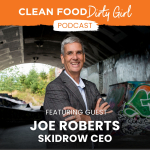
In this deeply moving and inspiring episode, I’m joined by Joe Roberts, a keynote speaker, CEO, plant-based endurance athlete, and advocate. Our paths crossed since his life partner is a longtime member of Clean Food Dirty Girl Recipe Club.
Joe shares his story of transformation from struggling with opioid addiction and experiencing homelessness in Vancouver’s Downtown Eastside at 22 to becoming the CEO of a multi-million-dollar business in just 12 years.
We talk about the power of human potential, the conversation with Gus and how it changed the trajectory of Joe’s life, and what happened when he pushed a shopping cart 5,625 miles across Canada to raise awareness and funds to help end youth homelessness.
We also get into plant-based eating and how his wife, Marie, adopted this way of eating while staying in an RV! Joes touches on how it transformed his athletic recovery and has supported his long-term health.
Here’s some of what you’ll take away from this episode
- Sometimes you need someone else to believe in you first. We talk about the power of having someone see your potential before you can see it yourself—and how one conversation can change the entire direction of your life.
- Your identity comes before your actions. Real, lasting change isn’t just about hitting a goal and becoming a different person. It’s about deciding who you are first, then letting your actions follow.
- Being fed up can be a good thing. That feeling of being stuck, uncomfortable, or completely over where you are in life can be the thing that gets you moving.
- You are not your past. Joe went from living under a viaduct in his 20s to running races in his late 50s. His story is a pretty damn good reminder that where you’ve been doesn’t get to decide where you’re going.
- Plant-based eating fuels endurance. Joe shares how eating plant-based has supported his long-term health and longevity.
- You don’t have to do it alone. Whether you’re recovering from addiction, changing the way you eat, or reinventing your life, having people in your corner can make all the difference.
Helpful links:
- Push for Change e-book access (Use password to open the PDF: W22G9ee7)
- www.SkidrowCEO.com
- Find Joe on LinkedIn or book Joe
- Plant-based documentaries (Earthlings inspired Marie to go plant-based)
- Marie’s creative business and Facebook page
- Brittany’s Sourdough Course and podcast episode
- Recipes mentioned from Recipe Club: Eggless Egg Salad, Marinated Carrot Dogs, and Caesar Dressing
- Check out Molly’s coaching program, Drop It Club
About Joe
Joe Roberts aka The Skidrow CEO is an expert on resilience and change. Having experienced both catastrophic failure and extraordinary success Joe teaches how to overcome the roadblocks that get in the way of high performance.
He helps companies and individuals redefine what’s truly possible by confronting limiting mindsets. Participants at Joes’ events leave inspired and moved to action.
What is most amazing about Joe is that in 1989 he was living on the streets of Vancouver as a homeless skid row addict. Through perseverance, determination and his resilient human spirit, Joe pulled himself out of darkness and despair, to become a highly respected business and community leader.
Transcript, auto-generated, may have errors
Molly: Hey there, and thanks for listening to this episode of the Clean Food Dirty Girl Podcast. Happy to have you here today. I have a special guest for you: Joe Roberts. If you don’t know about Joe and his story, you should, because Joe, you have an incredible, inspiring story that has inspired so many people. I’m really happy to have you on the show. Welcome! How are you today?
Joe Roberts: Good, doing really good. Thanks, Molly. I’m excited to be here. As I said earlier when we were prepping, you’re a legend in our home and kitchen. Marie, my partner in life, has been in my ear about all the different things, and you’ve been on our plate for the last four or five years. In fact, I just finished a whole bunch of the eggless salad and potato salad. Marie made like two liters. I’m excited to be here to talk and share.
Molly: That’s so great! I love hearing that, and I love how we connected. Your wife, Marie, was that link. She met someone from my team at a VegFest in Seattle a couple of years ago. Marie posts wonderful things in our community, showing pictures of the food she makes, and she’s been a member of our meal planning club for a long time. So, I was familiar with her. Then Brittany from our team said, “Marie is awesome, and her husband has a really incredible story. Let me see if we can get him on the podcast.” So I checked you out, and here we are. I love how we met organically through all of this dirty goodness.
Joe, for the listeners who don’t know your story, can you give us a recap of where you are today, what led to the man you are today, and all the incredible work you do?
Joe Roberts: Sure, I’ll do the Reader’s Digest version—although I realize people have to be a little older to know what that reference means.
Molly: I got that one!
Joe Roberts: When I was 22, I lived in Vancouver’s Downtown Eastside. I struggled with opioid addiction and was unhoused. On any given day, you could see me pushing a shopping cart, collecting cans and bottles. I thought that was it for my life. But I had some really good people who helped me take a look at my identity and see possibility in me. I got a second chance, went back to school, graduated with honors, went into business, and crushed it.
In less than 12 years, I reinvented myself from a guy living under a viaduct to the CEO of a multi-million dollar company. But I wanted to pay it forward. I believe our life is partly to be in the service of others. In 2016 and 2017, I took my business platform and walked across Canada pushing a symbol of homelessness—a shopping cart—for 5,625 miles.
What I believe in is human potential and possibility. The work I love to do most—where our two worlds collide—is asking how we reinvent ourselves and change enduring patterns. I became plant-based shortly after the walk across Canada after Marie discovered it first. Today, I’m continuing to push limits. I’m turning 60 in November and doing crazy 24-hour endurance races and three Half-Ironmans. I’m excited about helping other people see their potential.
Molly: That’s incredible. Thank you for that recap. There have been distinct chapters in your life. When you were experiencing addiction and houselessness, what changed for you? Did you try to get clean multiple times, or what led you out of that chapter?
Joe Roberts: There are three ways to answer that. First, spiritual alignment and divine intervention. Second, the pragmatic approach: I had the right people and processes to help me transition. Third, I was sick and tired of being sick and tired, driven by a deep sense of survival.
One day in particular comes to mind. I was sitting at a bus stop beside an older man named Gus, who was about 70. He looked at me and said, “Joe, you’re an amazing young man. If you got sober and cleaned your life up, you could do something extraordinary. There’s more to you than you can see.”
In that moment, I had dirty fingernails, a scruffy beard, unlaundered clothes, and really bad personal hygiene. For the first time in my life, someone other than my mom or dad spoke to my potential. That was a turning point. With the help of my mom, I entered detox, then a residential treatment program, and got into a community. That shifted my sense of identity.
People starting a plant-based journey often try to reach a goal so they can be that person, but I think it goes the other way around. We become that person, do the things we need to do, and then get the results. That identity change is how a guy who lived like that for 15 years begins a 35-year journey of sobriety. When we change how we see ourselves, what we do changes, and the results follow.
Molly: I talk about that a lot in coaching. I tell people to visualize the version of themselves at their goal and start being that person today. What I love is that it was someone else who saw that possibility in you first. That speaks to how important community is. How did that impact the rest of your life and the decisions you made after getting sober?
Joe Roberts: It colors everything I do today. It’s deeply embedded in how I see people. If you count the people who shaped who you are today, you can quickly name a few. But whose list would your name be on? We have the power to help people find their possibility.
In shaping identity, we vacillate between the old and new self, facing roadblocks. Others play a paramount role in reinforcing that new identity and saying, “You fell, that’s normal, let’s keep moving.” Eventually, you aren’t someone fighting to stay sober; you’re a person in recovery. I’m here today because over 10,000 people helped lift me up.
Molly: We can’t do this alone. Life is hard, and we don’t get an instruction manual. When I first got sober, I felt so fragile spiritually and emotionally. I was scared, and that pushed me to change. If someone listening right now is fed up with their situation, what would you say to them?
Joe Roberts: I’d say something unexpected: I’m glad you find yourself backed into a corner, because discontentment is the catalyst to change. Discontentment is when we finally say, “Enough, what do I have to do?”
We are the lowest version of ourselves that we can tolerate. If where you are bugs you, good, because that means something can grow out of it. As Gus said to me: there is more to you than your circumstances, your past, what others have said or done to you, or what you say to yourself. Starting right now, your future is spotless. It doesn’t matter what you ate yesterday; today you get to start again. That emotional turmoil comes right before transformation.
Molly: Thich Nhat Hanh says, “No mud, no lotus.”
What about the person who has made progress, but hits that middle point where it becomes mundane and the novelty wears off? When people lose motivation, what is your take on keeping them going?
Joe Roberts: A friend in recovery once said, “Commitment is the willingness to carry through with a decision long after the mood in which it was created has left.”
Possibility equals action plus inspiration, minus the removal of roadblocks. We need to polish up better reasons to commit. When we lose inspiration, action changes our state and emotion. Get into action, then reconnect with your purpose.
When I pushed a shopping cart across Canada for 17 months, 16 miles a day, it wasn’t just about a metric goal like losing 20 pounds. If your goal is just a number, the impetus to continue disappears once you hit it. My “why” was the young people I wanted to raise money for, so they wouldn’t end up in a gutter like I did. On days when it was minus 40 Celsius, that why got me moving.
When you get stuck, “get your shoes on”. It’s a metaphor for taking action.
Molly: I tell my weight loss clients that taking action builds motivation. Take the next best, smallest step.
How did you make the decision to transition to a plant-based diet? Was Marie the catalyst?
Joe Roberts: It was totally Marie. She watched a documentary while running the campaign in the RV and said, “That’s it, I’m done.” She threw herself into it and went plant-based while working 16-hour days on the road.
After the walk across Canada, I started doing endurance races, Ironmans, and triathlons, and I found nutrition was key to my recovery. If I ate properly within two hours of a 20-mile run, it set me up for the following days. For someone my age, paying attention to nutrition is paramount for recovery.
Marie and I actually dated in high school. She was my first crush, but she broke my heart for a guy in a band. Twenty-eight years later, we reconnected, fell in love again, and got married. She’s the brains and heart behind our organization. Left to myself, I’d be eating chips and garbage!
Molly: Did you transition slowly or all at once?
Joe Roberts: I’m an all-or-nothing person, so it happened quickly once I noticed the visceral difference in my recovery. But I still have days where I find my face in a bag of chips. Progress isn’t linear. My “why” now is wanting to be the 84-year-old running the New York City Marathon.
Molly: It’s great to hear your perspective because many people wrongly think you can’t be plant-based and do endurance sports. And I appreciate your honesty about eating chips sometimes. As Dr. Greger says, it’s what you eat the majority of the time that matters.
Joe Roberts: Exactly. If I’m doing this 94% of the time, I’m good. Don’t get overly analytical or OCD about it. Give yourself a break; the next moment is yours to own.
Molly: Finding that healthy middle ground is so important.
Joe Roberts: Speaking of going off the rails in a good way, Molly made me do it! I found myself out in the rain cooking marinated carrots on the barbecue. I was skeptical, but with onions, sauerkraut, mustard, and a whole wheat bun, we were giggling our brains out. Marie even shared the recipe with her family!
Molly: Carrots make surprisingly good hot dogs! And credit goes to my amazing team, too.
Joe Roberts: Shoutout to Brittany! Marie signed up for her sourdough course, started making awesome bread, and put a jar of starter in the fridge labeled “Gus”. She named it Gus because the community taught her there was more to her than she could see.
You and your team have no idea how far your reach goes. Gus spent nine minutes with me and changed my life trajectory, and now I’ve shared that message with over two million people.
Molly: That’s a true full-circle moment. Brittany created that course out of her own recovery journey. Proving to yourself that you can do something small—like baking bread or putting on sneakers—starts you on a whole new path.
Joe Roberts: Inside each of us is untapped potential. The tragedy of life isn’t that it ends too soon, but that we wait too long to begin out of fear. When we take frightful steps forward in a community, we discover who we are.
Molly: Do you still have to remind yourself of that potential?
Joe Roberts: Absolutely. I can be a motivational speaker who gets depressed in his hotel room! But the difference now is I have tools and a support network to pull out of a nosedive quickly.
Molly: What practical tools do you use?
Joe Roberts:
- Helping others: Getting out of my own head by being of service.
- Limiting media: Staying off social media and news, which sell fear and outrage.
- Physical state changes: Exercising, sound therapy, binary beats, or meditating.
- Journaling and vulnerability: Writing thoughts down or checking in with friends honestly on a scale of 1 to 10.
Molly: Cooking is that grounding tool for me. Joe, where can people find your book and learn more about your story?
Joe Roberts: People can get the book Skid Row CEO on Amazon or directly through our website, Skid Row CEO. I’ll also provide a link and code for your audience to access it. If anyone wants to connect for speaking events, find Marie or me on LinkedIn or our website.
Molly: We will put those links in the show notes. Thank you so much for your time and for sharing your story with us today, Joe!
Joe Roberts: Thank you, Molly, and thanks to Brittany and your whole team for the great work you do. Cheers!


This podcast is tagged as
Try Meal Plan Club for 10 days
Transform your food and life. No credit card or perfection required.